
Perry County Sex Offender Checks
The Pennsylvania State Police Megan's Law Public Website is the controlling source for a Perry County sex offender lookup. It supports name and location searches, a Perry County filter, Perry map and list views, notification options, and Perry registration sites. The portal is a Perry County public-safety tool. It is not a complete archive of every Perry sex-offense case, and it should not be treated as a court docket or criminal-history report.
Begin a Perry County lookup with the least ambiguous fact available. A correctly spelled surname can help with a known Perry subject. A Perry street address, city, ZIP code, or county search is often more useful for neighborhood awareness. Open the matching Perry profile only after comparing the displayed photograph and physical description. Even then, the Pennsylvania State Police says positive identification requires fingerprints. For Perry case history beyond the listing, use the Perry County court case lookup and read each disposition separately.
No separate Perry County Sheriff registry database or Perry alert app was found in the official research. That Perry-specific negative result is useful. Readers should not waste time looking for a Perry-branded roster or assume an unofficial Perry map is more current than PSP. Pennsylvania's portal supplies the Perry public listing, while the Perry courthouse and PSP Newport serve as local reporting sites. The state accuracy line handles questions about a Perry listing.
Searching Perry's Megan's Law Site
The official Pennsylvania registry begins every Perry search with an acknowledgement screen. Its Perry County warning matters: data may be supplied by Perry registrants or other agencies, may be late or inaccurate, and may not reflect a person's Perry location at the moment of a search. The registry also excludes people outside Perry public-disclosure rules. Accepting that notice opens the state interface for a Perry search.
The Perry warning also distinguishes a public notice from positive identification. A similar Perry name, physical trait, or hometown can point to the wrong person. PSP directs Perry users to treat fingerprint comparison as the only conclusive identity method. That standard is stricter than visual comparison, and it should shape how Perry County search results are discussed or shared.
The official registry screen shows the gateway Perry County residents use before entering Perry search criteria.
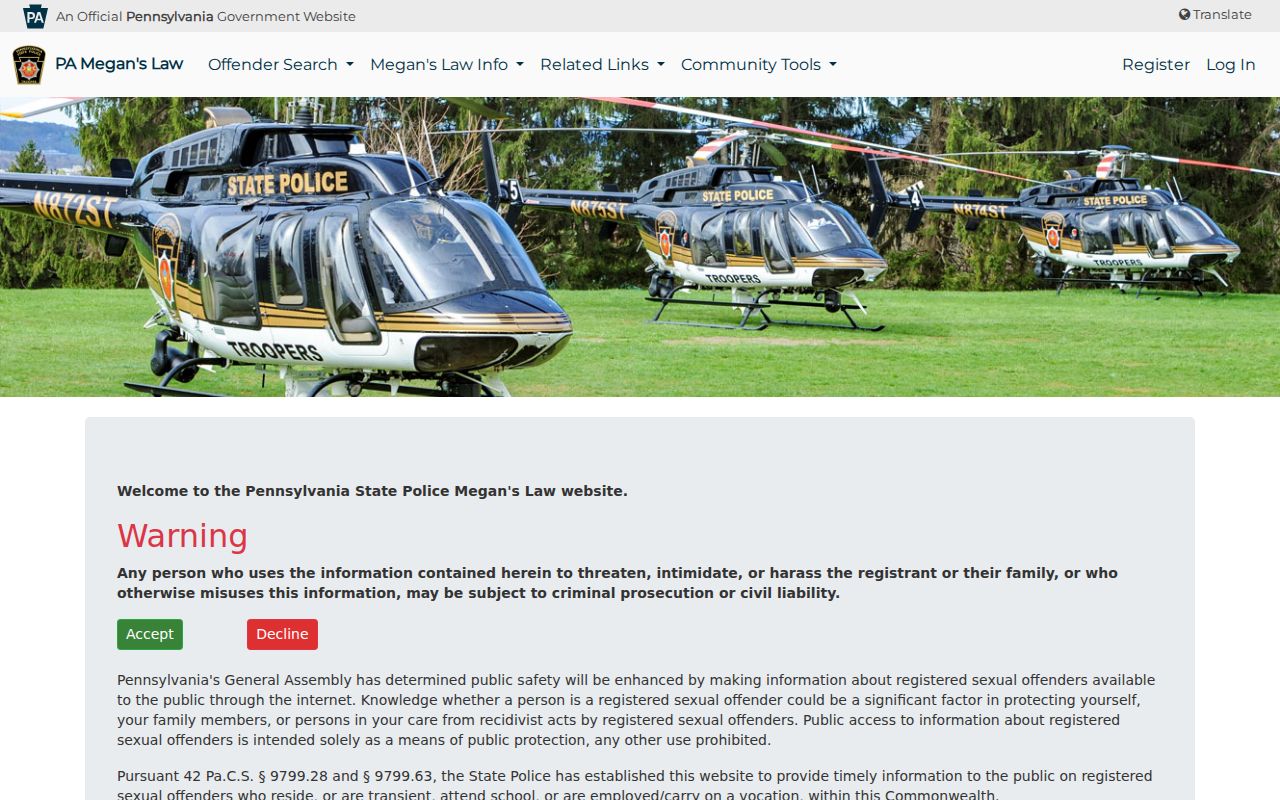
That warning should remain part of every Perry result: a Perry listing is a safety notice with defined limits, not proof of current conduct or exact present location in Perry County.
Pennsylvania State Police Megan's Law Public Website Searches
The Pennsylvania State Police operates the Perry search and maintains the public fields authorized by Megan's Law. Search by name for a known Perry subject or by location for a Perry County safety check. County and radius tools can narrow a Perry place search, while map and list controls change how the same Perry result set is viewed. Exact Perry radius choices can change, so use the options shown on the live form.
Perry email notifications are a separate optional workflow when the portal offers them. They can help a user monitor a Perry location or registrant under PSP choices, but a Perry alert still carries the same accuracy limits as the profile. Verification Sites is another separate Perry control. Selecting Perry returns official Perry reporting counters, not people who live near the counter.
- Open the PSP Megan's Law website, read its Perry limitations, and accept the conditions of use.
- Choose name or location search, then enter a surname or a Perry County address, city, ZIP, or Perry filter.
- Review Perry map or list results without assuming that a shared name or nearby pin proves identity.
- Open a plausible Perry profile and compare its photograph, description, classification, dates, and published location facts.
| Field Label | Type | Required | Notes |
|---|---|---|---|
| Last Name | Text | Conditional | Primary field in a Perry name search; check spelling. |
| First Name | Text | No | Narrows a Perry surname result. |
| Street, City, ZIP | Text / select | Conditional | Perry location criteria for an address-area search. |
| County | Select | No | Choose Perry to focus Perry results within the county. |
| Radius | Select | Conditional | Uses the current distance choices on the live form. |
| Map / List | View control | No | Changes Perry presentation, not the legal meaning of a result. |
Two Perry Registry Verification Sites
Perry County has two official registration and verification counters. The Perry County Courthouse is at 2 East Main Street, New Bloomfield, PA 17068, and can be reached at 717-582-2131. State Police Newport is at 155 Red Hill Road, Newport, PA 17074, with a main number of 717-567-3110. A registrant should call the intended site before reporting to confirm current hours and appointment needs.
These sites perform a statutory registration function. Their presence does not mean that the Clerk of Courts or PSP station can change a public profile on demand. Nor does it turn the courthouse into a separate Perry registry search portal. Public users search the statewide website. A person with a reporting duty uses one of the listed counters after confirming the procedure.
The PSP Perry County verification-site list documents both choices.
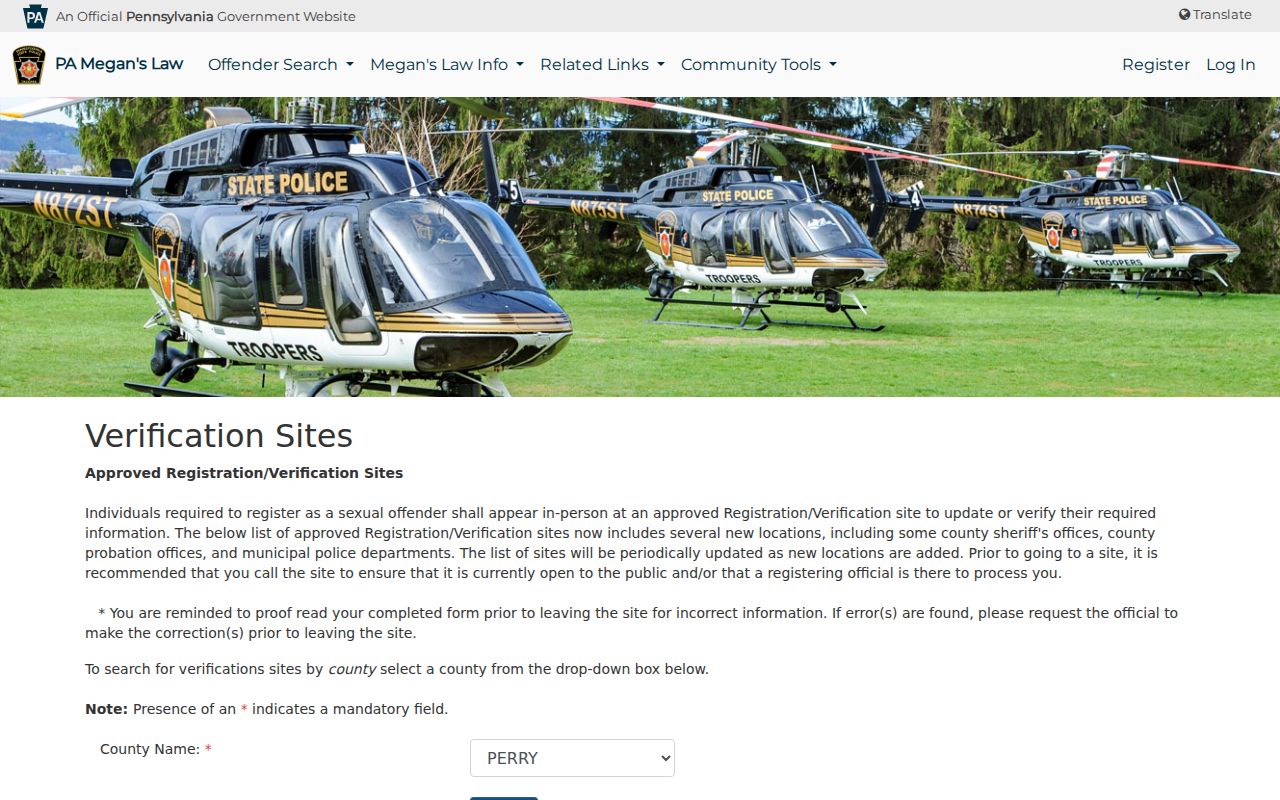
The two-site arrangement separates registry reporting from ordinary incident-report requests while giving Perry County registrants a county-seat and Newport option.
Registry Profiles: What They Show
A Perry public profile joins identifying, classification, place, and offense fields permitted by Pennsylvania law. Read the Perry fields together. A photograph and physical description can reduce a false Perry name match, but PSP still warns that fingerprints are the only positive method of identity. Perry residence, work, vocation, school, vehicle, offense, and verification information appears only to the statutory display level and may change after publication.
| Name & Aliases | Published identity names used to distinguish a listing. |
|---|---|
| Photo & Description | Photograph, sex, race, age information, height, weight, hair, eyes, and recorded marks. |
| Published Locations | Residence or transient status plus work, vocation, or school facts at the statutory level. |
| Offense & Statute | Description, jurisdiction, law, and conviction or adjudication details released by the portal. |
| Level / Tier | Tier I, II, III, or Sexually Violent Predator status where applicable. |
| Vehicles | Vehicle and registration details when authorized for public display. |
| Registration Status | Compliance or absconder indicators and registration or verification dates when published. |
Private identifiers and information outside the public statute are not promised by the profile. Missing fields do not establish that an underlying court file lacks them.
A profile's offense section also needs care. The published offense description and jurisdiction explain why a registration record exists, but the tier does not restate the whole criminal case. Appeals, orders, individual counts, and sentence events belong to court records. A public registry profile is built around notification duties, so it should not be read as a complete Pennsylvania rap sheet.
Perry Registry Identity Warnings
A familiar Perry name is not a verified identity. The Perry registry itself says fingerprint comparison is the only positive means of identification. Compare the entire public profile, not just a surname, age, or town. If the Perry listing still seems wrong, do not confront anyone. Report the suspected error to the Megan's Law Section at 1-866-771-3170 so the agency responsible for the Perry record can review it.
The same caution applies to dates and map markers. A registration address describes what the official system publishes. It cannot prove that a person is standing at that location now. A profile may also lag a properly reported change. Rechecking the official listing and using the correction line is safer than drawing a conclusion from an old screenshot.
Registration Levels and Duties in Pennsylvania
Under 42 Pa.C.S. § 9799.15, classification affects the general registration period and in-person verification cycle. A tier is not the same as the grade of an offense. Tier III does not mean “third-degree felony,” and a quarterly visit does not imply new misconduct. Juvenile, out-of-state, tolling, reduction, and older-law cases require the current statute rather than a simple table alone.
| Level / Tier | Duration | Verification Frequency |
|---|---|---|
| Tier I | 15 years generally | Annual in-person verification |
| Tier II | 25 years generally | Semiannual in-person verification |
| Tier III | Lifetime generally | Quarterly in-person verification |
| Sexually Violent Predator | Lifetime | Quarterly, with added statutory provisions |
Reductions and exceptions depend on the controlling subchapter and the person's record. The public page should be read as the agency's current published status, not as a substitute for a court order or counsel's review of registration duties.
Verification frequency states how often a registrant generally reports in person. Annual means once each year, semiannual means twice, and quarterly means four times. These cycles help maintain registry data. They do not show that the person committed a new offense between visits, and they should not be used as a measure of current risk.
Perry Registry Radius Versus National Search
A PSP radius search answers a Pennsylvania location question. The U.S. Department of Justice National Sex Offender Public Website searches participating jurisdictions across state lines. That second layer is useful when a family route, nearby address, or known person crosses Pennsylvania's border. It does not replace the PSP record for Pennsylvania details, classifications, correction channels, or local verification sites.
The systems also differ in authority. NSOPW connects participating public registries and offers broader geographic reach. PSP controls the Pennsylvania record it publishes. When the displays appear to differ, return to the relevant state or tribal source identified by the national result, check the update context, and use that jurisdiction's correction channel.
The official national portal provides the cross-jurisdiction search interface used for that broader check.
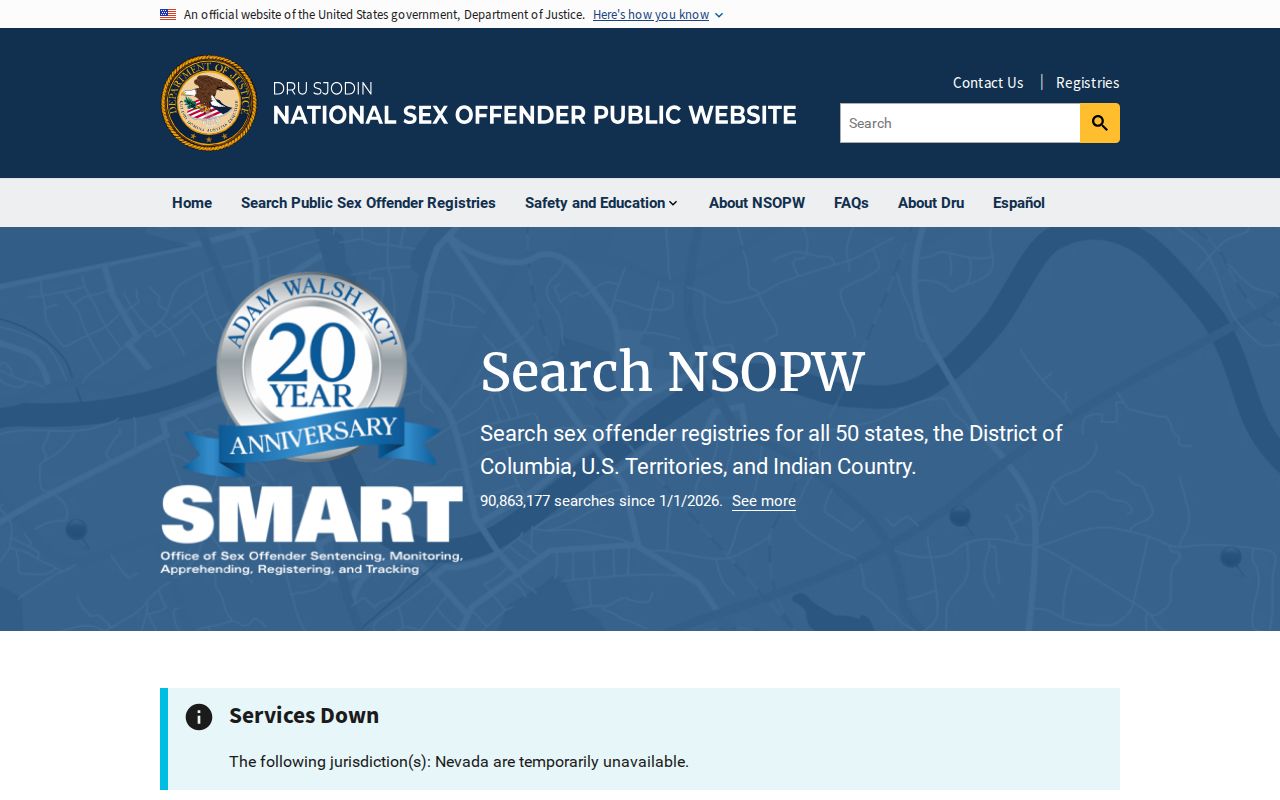
Use the national result to locate the responsible jurisdiction, then confirm a Pennsylvania entry in the PSP system and report suspected errors through the state line.
Correcting a Perry Registry Listing
An address or compliance entry can appear stale. First reload the official PSP profile rather than relying on a saved result. Note the displayed name, relevant location, status, and date without circulating the profile. Then call 1-866-771-3170 to report inaccurate information or suspected noncompliance. The Megan's Law Section can route the matter for review.
Do not turn a correction report into a personal investigation. Perry County's two verification sites serve the registration process, but public questions about an apparent absconder or outdated listing belong with PSP. Emergency conduct should go to emergency services. A disputed map pin is not a reason to approach a registrant, a household member, or a neighbor.
Using Registry Information Lawfully
The registry exists for public protection and informed safety planning. Readers may review place-based results, subscribe to portal notifications when offered, and return to the official profile when circumstances change. Those tools do not authorize retaliation, public shaming, threats, or interference with a registrant's family. Sections 9799.28 and 9799.63 of Title 42 define public-notification authority and the consequences attached to misuse.
Misuse has legal consequences: Threatening, intimidating, or harassing a registrant or household through registry information may lead to criminal prosecution or civil liability under 42 Pa.C.S. §§ 9799.28 and 9799.63.
Accuracy limits also shape lawful use. A map boundary is not exact proof of presence. The database does not list every historical sex-offense case, and it can contain late or inaccurate data. Confirm what the portal actually says, use official notification tools, and send possible errors or noncompliance to PSP rather than acting on an assumption.
Community awareness works best when the information stays tied to its source and date. Save the official link instead of copying a profile into a new list. Recheck a location before relying on it, and use the published agency channel for concerns. These steps preserve the registry's safety purpose without turning a limited public record into a claim it cannot support.